Applications Activated Carbon
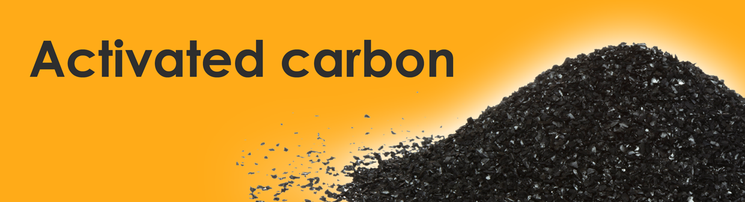
Activated carbon, also called activated charcoal, activated coal, is a form of carbon processed to be riddled with small, low-volume pores that increase the surface area available for adsorption or chemical reactions.
Classification
Granular activated carbon (GAC)
Granular activated carbon has a relatively larger particle size compared to powdered activated carbon and consequently, presents a smaller external surface. Diffusion of the adsorbate is thus an important factor. These carbons are therefore preferred for all absorption of gases and vapors as their rate of diffusion are faster. Granulated carbons are used for water treatment, deodorization and separation of components of flow system and is also used in rapid mix basins. GAC can be either in granular or extruded form. GAC is designated by sizes such as 8×20, 20×40, or 8×30 for liquid phase applications and 4×6, 4×8 or 4×10 for vapor phase applications. A 20×40 carbon is made of particles that will pass through a U.S. Standard Mesh Size No. 20 sieve (0.84 mm) (generally specified as 85% passing) but be retained on a U.S. Standard Mesh Size No. 40 sieve (0.42 mm) (generally specified as 95% retained). AWWA (1992) B604 uses the 50-mesh sieve (0.297 mm) as the minimum GAC size. The most popular aqueous phase carbons are the 12×40 and 8×30 sizes because they have a good balance of size, surface area, and head loss characteristics.
Powdered activated carbon (PAC)
Traditionally, active carbons are made in particulate form as powders or fine granules less than 1.0 mm in size with an average diameter between 0.15 and 0.25 mm. Thus they present a large surface to volume ratio with a small diffusion distance. PAC is made up of crushed or ground carbon particles, 95–100% of which will pass through a designated mesh sieve. Granular activated carbon is defined as the activated carbon retained on a 50-mesh sieve (0.297 mm) and PAC material as finer material, while ASTM classifies particle sizes corresponding to an 80-mesh sieve (0.177 mm) and smaller as PAC. PAC is not commonly used in a dedicated vessel, due to the high head loss that would occur. PAC is generally added directly to other process units, such as raw water intakes, rapid mix basins, clarifiers, and gravity filters.
Properties
A gram of activated carbon can have a surface area in excess of 500 m2, with 1500 m2 being readily achievable. Carbon aerogels, while more expensive, have even higher surface areas, and are used in special applications.
Activated carbon does adsorb iodine very well and in fact the iodine number, mg/g, (ASTM Standard Method test / JIS Standard Method test) is used as an indication of total surface area.
Activated carbon can be used as a substrate for the application of various chemicals to improve the adsorptive capacity for some inorganic (and problematic organic) compounds such as hydrogen sulfide (H2S), ammonia (NH3), formaldehyde (HCOH), radioisotopes iodine-131 (131I) and mercury (Hg). This property is known as chemisorption.
Iodine Number
Methylene Blue
Apparent Density
The solid or skeletal density of activated carbons will typically range between 2.0 and 2.1 g/cm3 (125–130 lbs./cubic foot). However, a large part of an activated carbon sample will consist of air space between particles, and the actual or apparent density will therefore be lower, typically 0.4 to 0.5 g/cm3 (25–31 lbs./cubic foot).
Hardness Number
Ash Content
Applications
Water
- POU/POE.
- Groundwater remediation.
- Wastewater treatment.
- Process water treatment.
- Municipal water treatment.
- Aquarium water treatment.
- Dialysis.
Air
- Vapor extraction/remediation.
- VOC abatement.
- Gas Mask.
- Indoor Air Quality (IAQ).
- Air stripper off-gas.
- Odor control.
- Catalyst support/protection.
- Tank venting.
Food
- Glycerin purification.
- Wine/fruit juice decolorization/deodorization.
- Edible oil purification.
- Corn and cane sugar decolorization.
Chemical
- Precious metal recovery.
- Glycol purification and recycling.
- Chemical or product purification.
- Sludge/soil stabilization.
- Catalyst support/protection.
- Amine purification.
- Dry cleaning solvent purification.
- Industrial oil purification.
- Solvent recovery.
Miscellaneous
- Ultra capacitor.
- Cigarette filters.
- Pharmaceutical.
- etc.
